

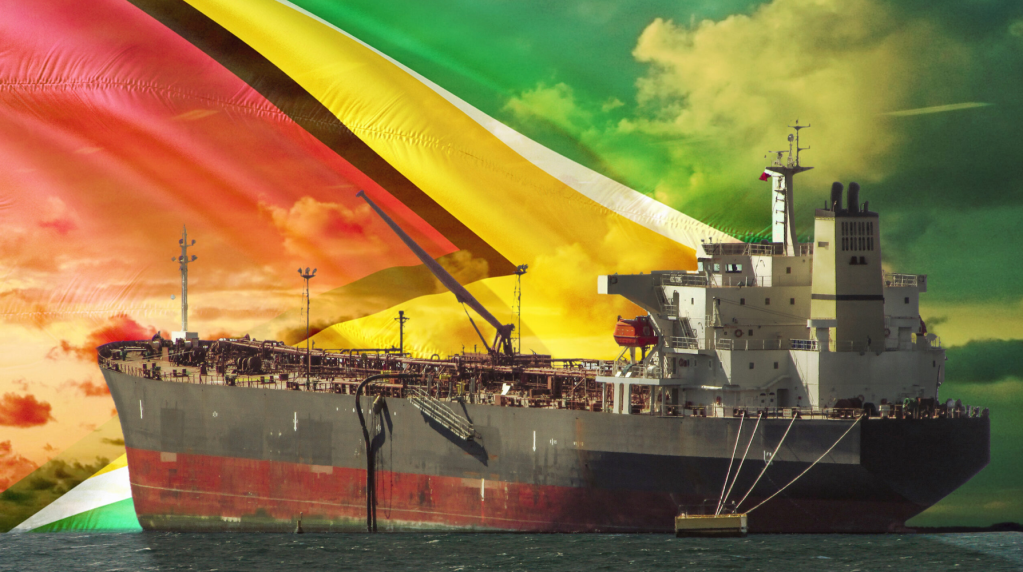
Guyana, a rainforest republic of fewer than 800,000 people, is poised to become the Western Hemisphere’s newest petro-power. The small Caribbean nation is sitting on an estimated 11.6 billion barrels of recoverable oil-equivalent—a volume greater than Mexico’s six billion. As foreign investors rush to stake claims in Guyana’s petroleum sector, the United States should act now to position itself as Georgetown’s partner of choice. Guyana’s oil windfall will unlock decades of investment in energy, infrastructure, and broader economic diversification, creating opportunities for American firms and workers well into the 2050s. For Washington, the strategic upside is clear: helping Guyana responsibly manage its oil boom would bolster regional energy security, open new channels for American exports, and counter the advance of rival powers in the southern Caribbean.
Guyana’s oil industry has expanded with astonishing speed. Since ExxonMobil’s first offshore discovery in 2015, output has surged from zero in 2019 to roughly 650,000 barrels per day, with six sanctioned projects expected to lift capacity beyond 1.3 million barrels per day by 2027. At that level, Guyana would out-produce Angola and reach roughly half the output of Kuwait—all within little more than a decade.
Oil receipts have already catapulted Guyana to the highest per-capita income in South America, driving real-GDP growth of 34 percent in 2023 and 43 percent in 2024. But converting a prospective trillion-dollar asset into durable prosperity will demand more than headline growth. Guyanese households and businesses still face frequent blackouts, soaring food prices, and crippling infrastructure shortfalls. The coastline lacks a modern deep-water harbor; rivers depend on aging pontoon bridges; hinterland roads are frequently impassable; and Guyanese electricity is among the most expensive in the region. Unless this windfall is channeled into broad-based economic development, Guyana risks the same “resource-curse” trap that has humbled so many commodity exporters before it. The country will need trusted partners and substantial capital to diversify its economy, overhaul its infrastructure, invest in its people’s education, health, and skills, and build institutions capable of managing a sovereign-wealth fund.
These frustrations were at the center of the bitterly contested 2020 election, which spiraled into a months-long political crisis. It took a national recount, international pressure, and American visa sanctions before the People’s Progressive Party took office. President Irfaan Ali is now seeking a second term on September 1, 2025, and is offering voters the promise of cheaper electricity, new highways, and thousands of jobs. His main rival, Aubrey Norton of the opposition coalition A Partnership for National Unity, is campaigning on a similar platform of infrastructure and inclusive growth.
Here, the United States should be leading—but China and India have moved first. A Chinese consortium is erecting the $260 million Demerara Harbor Bridge, Guyana’s “largest public works project to date,” while India is financing and building the $106 million East Coast-East Bank highway. Washington’s profile is more muted. Its principal initiative—a $526 million Export-Import (EXIM) Bank loan for a 300-megawatt gas-to-energy plant near Wales—remains bogged down by procurement and capacity challenges. Meanwhile, U.S. engineering firm Bechtel has proposed a deep-water port at the mouth of the Berbice River and a rail-and-road corridor linking Brazil’s Amazon interior to the Atlantic—projects of enormous strategic value not only to Guyana but to South America.
External security pressures add urgency. Venezuela claims two-thirds of Guyana’s territory, including the waters that hold the oil, and has already detained Guyanese fishing crews and harassed survey vessels. Guyana’s Defense Force numbers fewer than 5,000, while Caracas reportedly fields more than 100,000 personnel equipped with Russian fighter jets, tanks, and air-defense systems. During a March 2025 visit to Georgetown, U.S. secretary of state Marco Rubio cautioned that any aggression would trigger “a very bad day” for Caracas and signed a bilateral defense memorandum—a framework that could mature into the kind of security partnership that the United States has extended to countries such as Qatar and UAE.
Encouragingly, the kind of partnership Guyana needs meshes exactly with President Donald Trump’s second-term doctrine and his administration’s broader realignment of American foreign assistance policy, which has shifted away from traditional grants in favor of strategic investment. The U.S. International Development Finance Corporation (DFC) and EXIM Bank are now mandated to deploy American capital where it advances national interests and yields a return for U.S. taxpayers; few opportunities fit that mandate better than Guyana.
In the coming months, the administration should release the EXIM funds for the Wales plant; extend EXIM and DFC support for the development of other logistics corridors; issue a cabinet-level declaration committing the United States to Guyana’s long-term development; and translate the defense memorandum into joint coastal radar, regular naval patrols, and capacity-building for Guyana’s forces—delivering the sort of deterrence that protects partners in the Gulf.
Executing these steps before September would secure a new Atlantic source of energy under Western standards, establish a Brazil-to-Caribbean trade artery, and prove that “America First” can also mean “allies prosper.” No lower-cost, higher-leverage opportunity exists in the hemisphere. If the United States intends to lead, the moment to act is now.
Originally published in the National Interest

 Daniel F. Runde
Leave a comment